



Shop for the perfect outfit for your little one! Check out our selection of baby costumes
Shop one of the largest inventories of plus size costumes online!

General Dryer Information
DRYER BASICS....please read on....
Always remember Electricity is dangerous and should be treated with respect.
- Blowing house fuse after the dryer runs for a while ( same as tripping the house breaker after the dryer runs for a while )
- Changing from a 3 to 4 wire hookup on an electric dryer
- Dryer basics- Venting problems and power supply
- Dryer Basics - Dead dryer
- Dryer Basics - Cord plug and receptacle problem
- Dryer Basics - timers and how they work
- Dryer repair -common- flow chart....Click here.
- How do dryer thermostats work?
 How do dryer thermistors work?
- How long can my vent for the dryer be?
- How the belt is suppose to look at the motor and idler pulley.
- Important Disclaimer
- If your drum belt looks like either of these...change it.
- My dryer door won't stay closed or won't latch properly
- Repair manuals - save $$
- Vent cleaning help kit
- What is a grounded heating element on an electric dryer?
- Wiring help for the 4 prone receptacle
Q. We have a dryer ( could be any make! ) that is consistently blowing fuses after about 15-20 minutes. We have taken the dryer apart to check for clogs in the venting system and to check if the heating core was okay and they seem to be fine. Any ideas?
A. Blowing the house fuses? If yes....the dryer usually will blow a fuse right away if there is a problem in the dryer....more often than not a fuse that blows after the dryer has been running a while it is a fuse box issue. A test: Put 2 new 30 amp fuses in and run the dryer with the heat on for 5-10 minutes, turn off the dryer and quickly remove the fuses from the house fuse box and see if they are hot at all ( especially on the bottom )....if the fuses are getting hot they are probably melting the fuse link and not really blowing = fuse box problem.
As for most things there are exceptions....a grounded heating element -may- blow the fuse after the dryer has been on for a while, it is easy to test for that as well. See link here. A burnt/loose power cord/plug -may- also give this type of a problem.
Dryer basics- Venting problems and power supply:
Most dryer "to long to dry" or "poor/low heat" complaints can be traced back to a bad or poor venting system and sometimes a poorly maintained lint filter. Do not go outside and put your hand under the vent opening and say " it is fine - I feel air coming out"...that is not good enough...take your venting apart, clean it ALL out and make sure the vent hood flapper works and that it is not clogged with lint. Make sure your venting system is short, straight and resistance free as possible. A poor venting system will shorten the life of your dryer, plug up the fan blower and duct work inside your dryer as well. Tip# 4.
Gas dryers need 120 volts to operate the whole dryer. Electric dryers need 240 volts to operate the heating element and 120 volts to operate the timer and motor. You should see 240 volts between the black and red wires, 120 volts between the red and white wires, 120 volts between the black and white wires at the electric dryer main power harness. A blown house fuse ( or breaker ) would stop a gas dryer from working at all. A blown house fuse ( or a 1/2 tripped breaker ) would still allow the electric dryer to run but you would get no heat. Depending on which fuse goes, sometimes the dryer could be dead as well. If you have problems with a fuse letting go or a breaker tripping after the dryer runs for a while, normally the problem is not in the dryer but is in the fuse box.
Dryer Basics - timers and how they work:
Timed dry cycles on a timer are the simplest timer cycle. The timer motor receives 120 volts and just advances all the way from where you set it to the off position. Example- You set it for 50 minutes, it will run for 50 minutes and shut off. The AUTO cycle is a little different. The operating thermostat cycles off and the power is redirected to the timer motor to advance the timer to the off position. There is no power to the timer motor until the thermostat cycles the heat off and then that power is directed to the timer motor. If your timer will not advance in timed and auto dry...probably a bad timer or wire. If your timer will not advance in AUTO dryer but will advance in timed dryer...problem is normally not your timer.
Dryer Basics - Dead dryer:
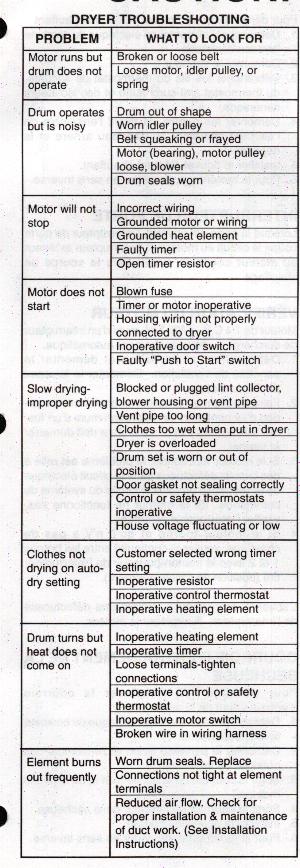
Common problems...blown house fuse, broken belt ( on some models )...door switch...*thermal fuse open ( venting needs attention )...broken or burnt wire....timer....motor, in order from most common to least common. * If you find a blown thermal fuse, always clean, change, adjust the venting system and vent hood first, then it is often a good idea to replace the operating thermostat at the same time. This is a picture of some modern thermal fuses.
Changing from 3 to 4 wire hookup on a electric dryer:
This is an example of a three wire connection dryer cord hookup. Notice that there is a ground strap connected from the common center terminal to the frame of the terminal block. Place the center wire of the cord on the center terminal [ one with the ground strap on it ] and the other two wires will be placed on the outer terminals and it doesn't matter which wire goes right or left. Get the center wire of the cord right and you are in business.
This is an example of the 4 wire dryer cord hookup. Notice that the ground strap has been removed from the terminal block frame and folded back onto the center terminal for storage. You can see the colors of the other hookups. TIP: White always to the middle.
Dryer Basics - Dryer door won't catch properly:
Dryer doors have a latch and catch assembly that often wears out. Many are a plastic device, but some are made of metal. Usually a kit is available with both parts coming as a kit.

Related Links

You Can Search APP's Massive Selection of Appliance Parts, But Did You Know They Also Have Parts For These...